By John Jones, Club Historian
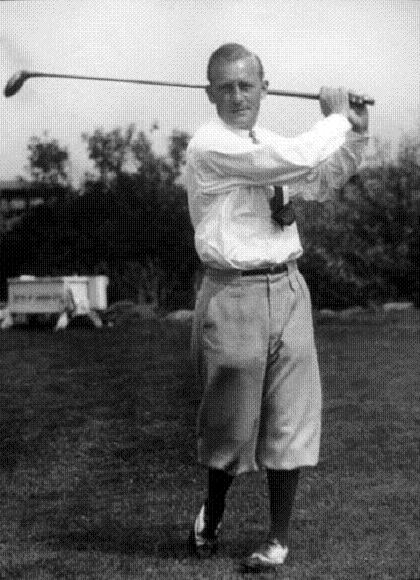 George Von Elm was born in Utah in 1901. He learned golf as a caddy at the old Salt Lake Country Club and won his first Utah State Amateur at 16 years of age. He added two more Utah titles before leaving the state to win the Pacific Northwest Championship by defeating 1904 and 1905 U.S. Amateur Champion, Chandler Egan. He later won the prestigious Trans-Mississippi Championship title in 1921.
George came to Los Angeles in 1922 and won his first Southern California Golf Association Amateur Championship title at Flintridge Country Club against Everett Seaver. He was introduced by SCGA President Ed Tufts at the trophy presentation as "The kid who has yet to take his first shave", and whose long driving "had never been seen in the South before" which included a 320 yard drive to the edge of the 5th green.
George won three cups and a Gold Medal for his efforts that week; The Spalding Perpetual Challenge; The SCGA Cup; the Medal Round Cup and the SCGA Medal. George had arrived!
In the summer of 1922 he again won the Pacific Northwest Championship title but soon after was shocked to learn the United States Golf Association had banned him for 1 year from all amateur play for receiving expense money from his friends in Salt Lake City.
He returned home and took a job at a bank.
A year later in the autumn of 1923, George returned from his ban only to get beaten by Francis Ouimet in the 1923 U.S. Amateur Championship held at Flossmoor CC in Chicago. He moved to Los Angeles and joined Rancho Golf Club under the tutelage of resident pro Arthur Clarkson.
In early 1924 George lowered Clarkson's course record by 4 strokes on the then very difficult Herbert Fowler layout shooting an historic 64. The course record that stood the test of time until the golf course was re-designed by George and Billy Bell in 1947.
Throughout 1924, George was paired many times with Rancho Golf Club Secretary and former British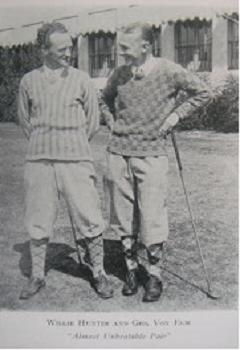 Amateur Champion Willie Hunter, who was also banned from amateur competition by the USGA at the same time as George. George played in numerous exhibition matches against the hottest touring professional and amateur golfer's in the country (common in the days before the PGA Tour), and teamed with Willie to form the unbeatable duo representing Rancho Golf Club in the SCGA Inter Club team play matches.
George's record in 1924 includes winning the Low Medal competition at the California State Open played at Los Angeles Country Club; the Flintridge CC Invitational; the Los Angeles City Championship on the Harding course at Griffith Park (returning the cup later because he couldn't play in the weekend matches); at Rancho Golf Club where he won the Rancho Invitational; again at LACC where he won Low Medal honors in their Invitational; the Wilshire Invitational and the Brentwood Invitational.
In October, at the Merion Cricket Club in Pennsylvania, George was defeated in the final match of the 1924 U.S. Amateur Championship by Bobby Jones, who went on to win the first of his five titles beating George 9 and 8. Although most of George's approach shots were pin seekers, the Atlanta lad's unbeatable putter was running white hot in the morning round and couldn't be matched by George as a gallery of 5,000 fans witnessed the contest.
In 1925, George won the Northern California Amateur Championship title; the Southern California Amateur Championship title by the largest margin of victory in SCGA match play history, 12 and 10 over Norm Macbeth, a record that remains today; and the La Cumbre Invitational tournament. In September, he traveled back east only to lose again to Bobby Jones, 7 and 6 in a semi-final match for the 1925 U.S. Amateur Championship played at Oakmont CC. Bobby Jones claimed his second title in a row.
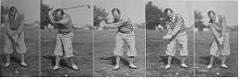
On the local level, George won the California Amateur Championship; the Rancho Invitational; and the Southern California Open that included Walter Hagen and other professional golfers. Always looking for an opportunity to play, George also represented Rancho Golf Club in SCGA team play competition.
 His sizzling play continued in 1926. With a near miss of winning the title, he settled for second place at the inaugural Los Angeles Open organized by the Los Angeles Athletic Club and held at LACC. He helped Rancho win the SCGA team play title and individually won the Rancho Invitational again.
He finished third at the British Open and won handily as a member 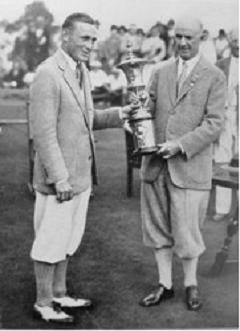 of the victorious U.S. Walker Cup Team played at Royal St. George's. Upon returning to the United States, George was not to be denied on his third attempt to beat Bobby Jones, 2 and 1 to capture the 1926 U.S. Amateur Championship title at Baltusrol Golf Club in New Jersey.
Heralded as one of the great sports upsets in 1926, Rancho Golf Club members and the entire City put on a show to honor the great Rancho, California and National Champion upon his return to the City of Angels. Funds were collected by club members to present George with a brand new car in recognition of his great achievement.
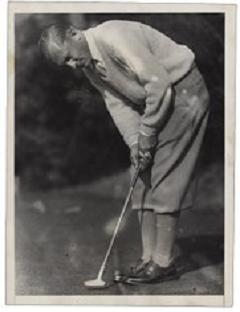 George's hot putter could not be stopped in 1927. As captain of Rancho, he led the club to victory in the SCGA team play finals over Lakeside CC with the help of young billionaire Howard Hughes and close friend Leon Keller to take home the inaugural Peter Cooper Bryce Cup. George went on to win the Southern California Amateur Championship title for the third time and in September was crowned the Medal Winner of the 1927 California Amateur Championship.
George's winning ways continued through the end of the 1920's winning the prestigious Golden Mashie and Agua Caliente amateur tournaments. He was also invited to play in various exhibitions matches against Walter Hagen, Bobby Jones, Tommy Armour and other legends of the Golden Era.
Following the Stock Crash in October of 1929, George reduced his playing time yet led Rancho to another SCGA team play title in 1930. By September 1930, George announced his retirement from the ranks of amateur golf. He explained the cost to participate on the Walker Cup team; both British and U.S. Amateur Championships; and traveling across the great State of California was $10,000 a year. He had spent over $50,000 during the previous years to pursue his passion of playing the best and beating the best.
His announcement emphasized the winnings were to offset his expenses and not a career change from selling insurance. He defined his new status as "Business Man Golfer", stubbornly hanging on to his belief that golf was a gentlemanly pursuit, not a professional career, and that he should be allowed to accept money for his expenses. He closed by stating " If the money doesn't meet the expenses of competition, I shall thereafter give up tournament play altogether."
n 1931, still playing with hickory shafts in professional tournaments, George lost to Billy Burke in the first U.S. Open to be broadcast over radio. George was there to witness the future as Billy was the first professional to win using steel shafts. After two successive 36 hole play-offs in a sweltering heat wave at Inverness CC, with the new 1.68 inch Balloon golf ball, Billy prevailed by one stroke on the last hole. It was the longest play-off in US Open history and a PGA record that remains to this day. 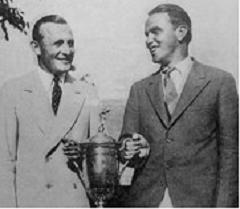
Years later, it was reported that on the morning of the last play off round, George received news that fellow Rancho golfer Leon Keller had died in a plane crash on his way to Pebble Beach for the State Amateur Championship. Legendary journalist, photographer, Rancho life-member and avid golfer Scotty Chisholm wrote in his memoirs that George cried like a child when told of the tragic news. The 1931 U.S. Open was the last USGA championship to have a 36 hole play-off and George would never get another chance to play in the final pairing of a major tournament.
George continued to play professional tournaments closer to home after his 1931 U.S. Open loss winning the 1936 Southern California Open.
In his early 40s, he joined the U.S. Army and supported the war effort during World War II. By 1945, he joined Lakeside Golf Club to play with past Rancho members who moved over after the IRS closed Rancho Golf Club in 1933. He served the membership as Chairman of the Lakeside Greens Committee overseeing the reconstruction of five Max Behr designed holes destroyed in a flood.
Known for his passion for the game and volunteer work in the Southern California golf community, George consulted to the City of Los Angeles with the redesign of the new Rancho Park Golf Course between 1947 and 1949, working closely with legendary golf course architect Billy Bell. George continued to play ;ocal and regional tournaments continuing to win into his late 40's.
In 1950 George left Lakeside CC to pursue a new career. For the first time in his life, he became the head Professional at Hacienda Country Club where he was also Head Greenskeeper.
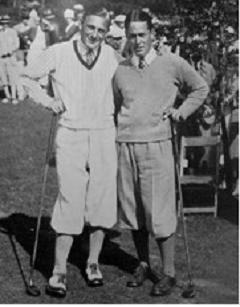
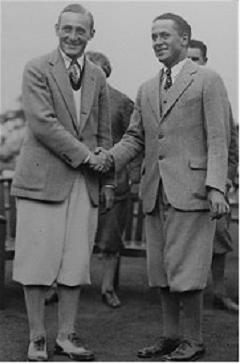 In 1951 he reunited with Bobby Jones at Augusta, GA during the Masters Tournament where the two old friends posed together for the press, one last time after both had retired from amateur play 21 years earlier in 1930.
In 1952, PGA members and sports writers voted George Von Elm the 10th most important amateur golfer in U.S. history, getting recognized in the Mid Century Honor Roll.
In 1953 George suffered from a ruptured ulcer which nearly cost him his life.
In 1954, George left Hacienda CC after family matters caused him to move back to Salt Lake City.
In 1955, the Los Angeles Athletic Club honored George as one of Southern California's All Time Greats.
Adding to his life time membership of Rancho Golf Club, Los Angeles Country Club and the L.A. Athletic Club among others, George Von Elm was added to the Permanent Masters List in 1957.
George is credited for designing golf courses at Shadow Mountain in Palm Springs; and Juniper Hills, Highland and Blackfoot in Idaho among others before he passed away in 1961.
In the 60 years of George Von Elm's life, he won a multiple of regional and National golf championship titles as an amateur; as a team player for the United States, Rancho Golf Club and Los Angeles CC; and as a "Business Man Golfer" refusing to be labeled a Pro.
By beating Bobby Jones in the 1926 U.S. Amateur Championship, he will always be immortalized along 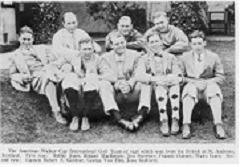 with his 3 Walker Cup winning teams and many top ten finishes in the British and U.S. Opens including his famous second place finish in the longest play-off in USGA history against Billy Burke in 1931.
George Von Elm is one of only two men with the distinct honor of holding the Southern California Amateur, Northern California Amateur, and California State Amateur Championship titles at the same time. Charles Seaver is the other.
George Von Elm is one of only two men to have won the Southern California Amateur and the U.S. Amateur championship titles. Tiger Woods is the other.
George Von Elm was one of the greatest golfers in America in the 20th century and second only to Bobby Jones in amateur play.
George Von Elm was a die hard Rancho Golf Club member. When word circulated he was quitting the club after defeating Bobby Jones in 1926, George stopped the rumors by announcing "He will remain Vice President of Rancho Golf Club as long as the grass grows on the greens."
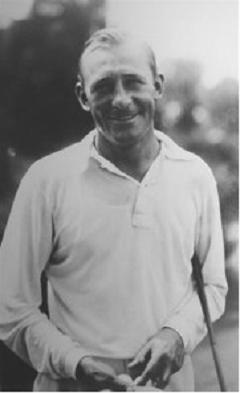
George Von Elm set scoring records over many of the toughest courses in America against the best amateur and professional golfers of his day. His brand of honorable golf, adherence to the Rules and loyalty to Rancho Golf Club will not be forgotten.
Copyright 2007 - JIBJones & Rancho Park Golf Club
Not to be copied or reproduced without the written consent of the Copyright Holder